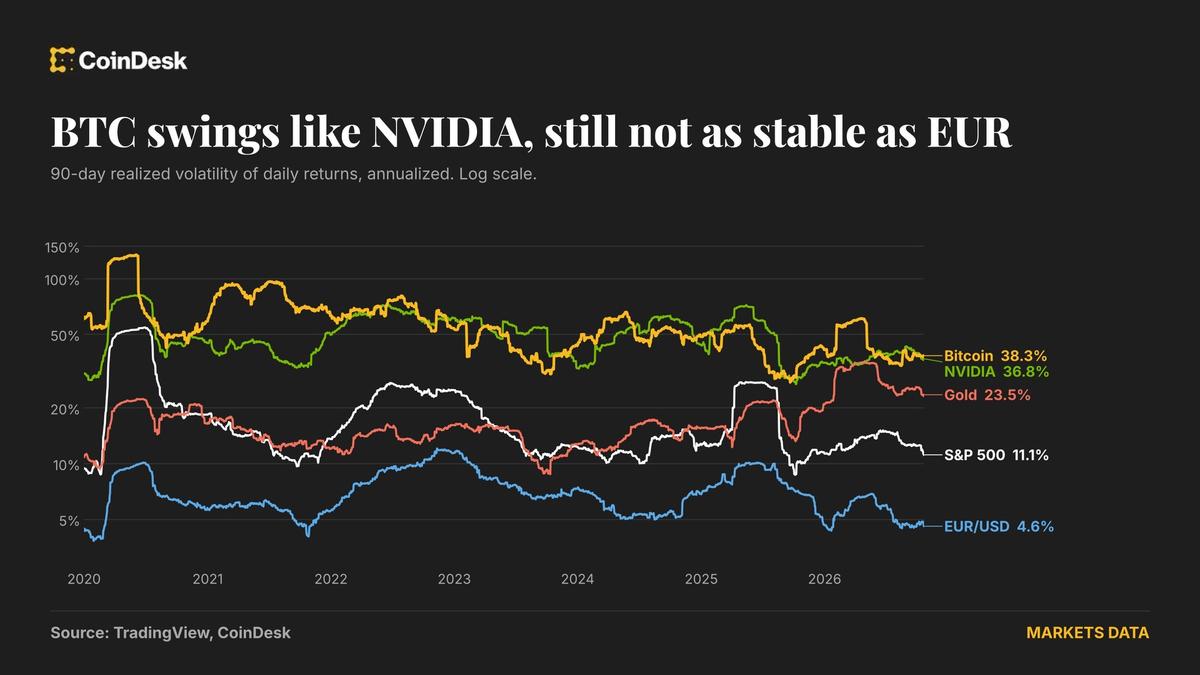
Bitcoin’s recent price swings have moderated to roughly the level of Nvidia’s, but the cryptocurrency remains substantially more volatile than gold, the S&P 500 and the euro-dollar exchange rate.
Realized volatility measures the standard deviation of daily returns over a defined period, typically annualized. It describes the size of recent price movements rather than their direction or a forecast of future returns. On that basis, bitcoin was a little more than three times as volatile as the S&P 500 and roughly eight times as volatile as the euro-dollar pair.
The gap with currencies remains especially wide. EUR/USD volatility stayed in single digits despite uncertainty surrounding French government debt and a recent decline in the euro. Most fiat-currency pairs also remained below 10%, leaving bitcoin well short of the stability associated with major national currencies.
Bitcoin’s current reading nevertheless represents a marked reduction from its longer-term levels.
Forward-looking options measures showed a different balance between the two markets. BVIV, an index designed to represent expected 30-day bitcoin volatility from derivatives-market data, remained below its 200-day average. That combination indicated comparatively restrained near-term expectations for bitcoin alongside greater uncertainty being priced into U.S.
The distinction matters for portfolio construction: a calmer options signal does not change the fact that bitcoin’s recent realized swings have been much larger than those of traditional benchmarks. Volatility data can therefore show a cryptocurrency that is becoming less turbulent over time while still adding materially more risk than currencies, gold or diversified stock indexes.