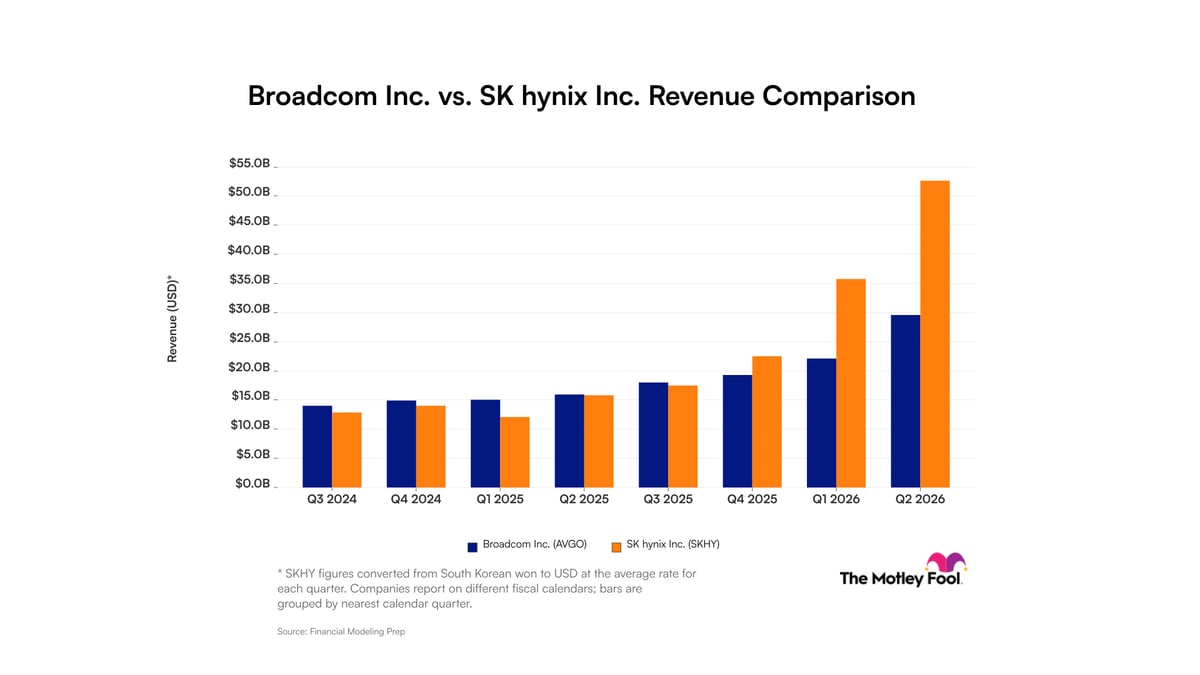
Broadcom and SK Hynix are benefiting from artificial-intelligence demand, but their revenue paths reflect different businesses. Broadcom sells semiconductor solutions and infrastructure software used across networking, broadband, telecommunications and industrial automation. SK Hynix focuses mainly on memory products, including DRAM and NAND flash components designed for customer applications.
13, 2026, Broadcom showed steadier quarter-over-quarter gains. SK Hynix remained behind Broadcom until overtaking it at the end of last year, then accelerated sharply in 2026 as demand for high-bandwidth memory, or HBM, increased.
HBM is suited to AI systems, and a broader memory shortage has supported higher prices for SK Hynix’s products. The company also increased production of advanced chips in late July and announced a manufacturing-technology collaboration with Taiwan Semiconductor Manufacturing Company in September. Its legacy memory products, however, continued to face price pressure.
Broadcom’s growth has been less explosive but is tied to a broader mix of networking hardware and software. The company secured a multiyear private-cloud partnership with Standard Chartered in July, while an expanded European antitrust inquiry in September examined updated software-licensing requirements. Its VMware division links infrastructure software with its hardware business, supporting a revenue model that the supplied analysis characterizes as more incremental and reliable than one driven by commodity memory pricing.
The comparison leaves investors weighing two different forms of AI exposure: SK Hynix’s rapid expansion in a memory market that can move cyclically, and Broadcom’s steadier progression through networking and infrastructure software. The supplied analysis says SK Hynix’s current surge could eventually give way to a downturn, but it does not establish when that might occur.